

The Positioning Framework Behind High-Converting Offers
+ Full Positioning Report.

How do you define who you are as a solopreneur?
Because your solopreneur identity isn’t the entirety of your identity. It’s a part of it—affected by all other parts, but separate nonetheless.
And in defining it, most people go one of two ways.
The first is the entrepreneurial way.
You ask yourself, “What does my audience / clients want?” and you adjust your solopreneur self to fit that.
If you’re naturally entrepreneurial—and that’s an important if—you will choose this road. As a result, you’ll find it easy to achieve business goals others struggle with. You’ll make more money, faster. You’ll gain more attention, faster.
But there’s a cost.
It’s easy to become a commodity. It’s difficult to differentiate yourself from thousands of others who solve the exact same problems.
The second way to define who you are as a solopreneur is the artistic way.
You ask yourself “Who do I want to be?” and you adjust your solopreneur self to fit that.
If you’re naturally artistic, you will find yourself compelled to go this route; to ignore what people want and do what you want to do.
But if your artistic self fails in achieving your professional goals—and it probably will, at least in your mind, because you will compare yourself to the results of entrepreneurial solopreneurs—you suffer.
And suffering does what suffering always does.
It will change you, at least for a bit. You’ll try to give people more of what they want, and perhaps you’ll succeed for a while.
But solopreneurship is inherently personal. If your business doesn’t align with who you are, you will inevitably give it up or want to change it again.
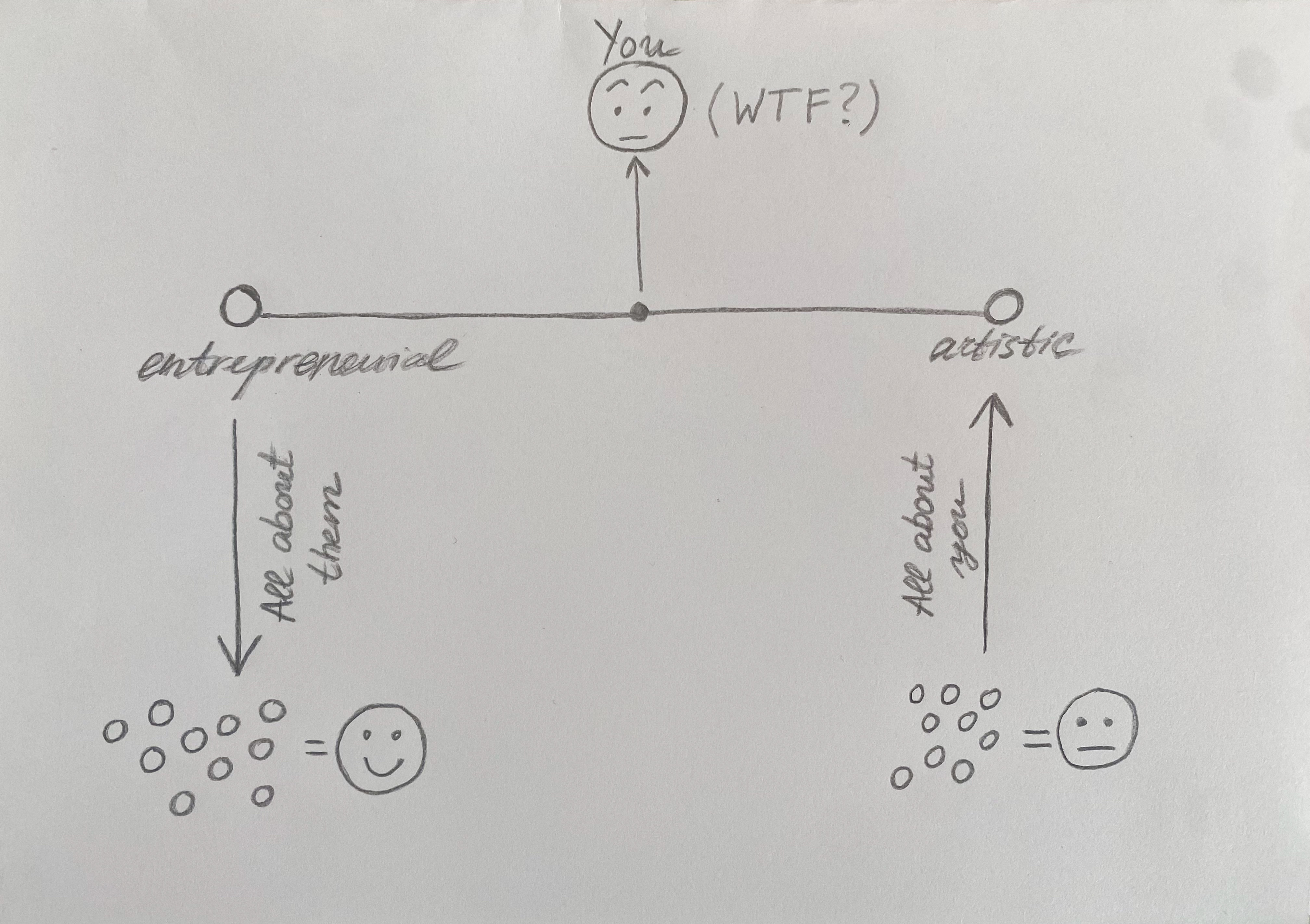
Now, here’s the uncomfortable truth.
We can’t change who we are. Not really. Not in a foundational way.
Entrepreneurial solopreneurs will always spot the gap in the market.
Artistic solopreneurs will always hear the inner voice first.
Instead of changing yourself to please the market, learn positioning.
Soft positioning will infuse your work with unmistakable personality.
Hard positioning will make your offers unmistakably valuable.
And you can blend them so your business becomes rooted in who you are, but able to flow and adapt.
That’s what we’re doing today.
In this newsletter:
→ What positioning is and why it matters
→ What soft positioning is
→ What hard positioning is
→ Warning about misusing positioning & how to use it properly.
What is positioning & why it matters.
People do not buy without a position. If you don’t choose your position, your market chooses it for you.
When someone finds you online, their brain asks two questions instantly:
What is this?
Is this for someone like me?
This happens in milliseconds.
If you don’t answer those questions clearly, the brain answers them without your input, using whatever information it can gather (your tone, your content, your niche, your topics).
And because humans are lazy categorizers, the brain almost always does this:
“Oh, this looks like X. I already know what X is. Done.”
Meaning, you get lumped into the nearest familiar box, even if it’s the wrong box. People will always choose the most obvious, lowest-resolution interpretation of who you are.
“Ah, another mindset writer.”
“Another online business coach.”
“Another productivity newsletter.”
“Another freelance designer who does logos.”
None of these are insults, but they’re generic. Generic = low willingness to pay.
Buyers need a reason to pay you vs the other 1000 like you. To make this decision, they usually default to price, personality, or popularity.
If you’re not the cheapest and you’re not super popular, personality (=positioning) is the only ace up your sleeve.
There are two types of positioning. I find most solopreneurs need to work on hard positioning, but some are very hard and need a softer touch.
Let me elaborate.
